

Review by Fr. Dr. Thomas Kottoor
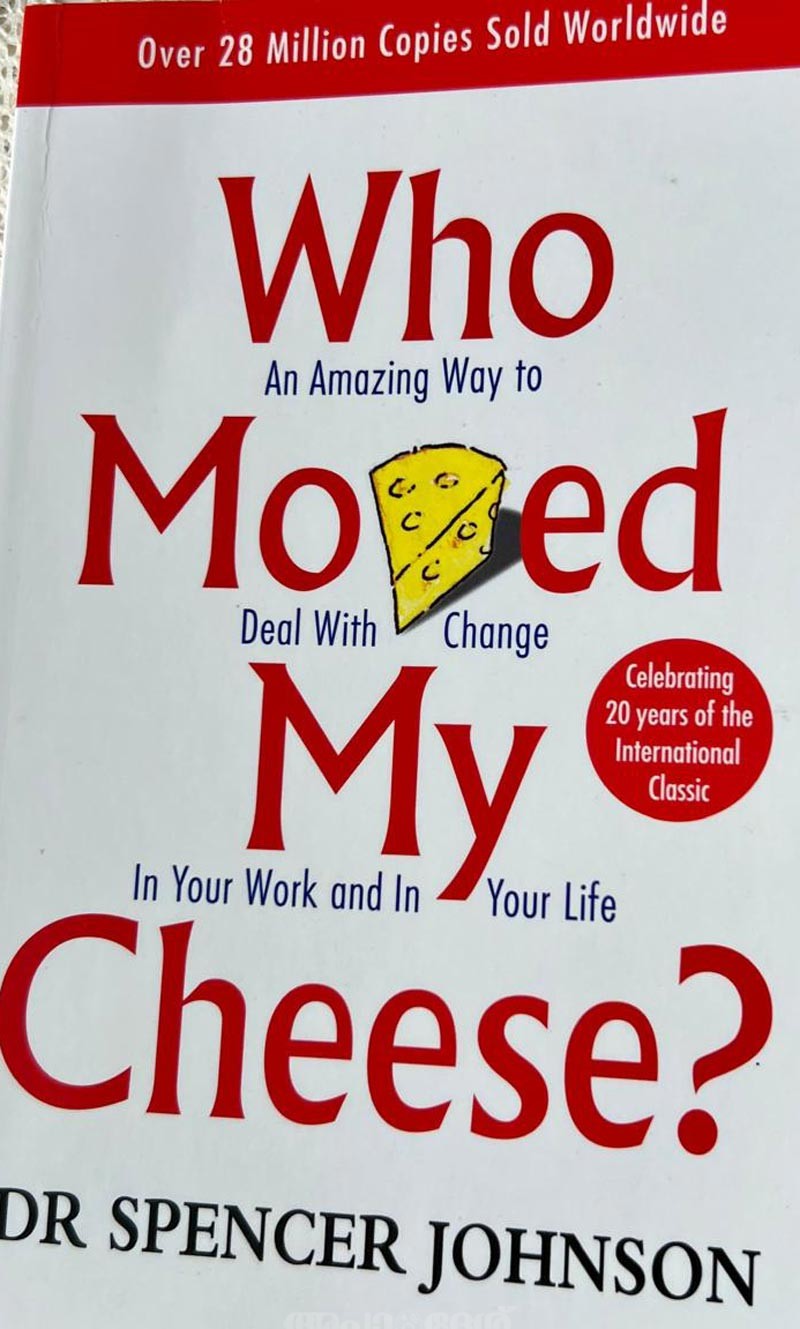
Never judge a book by its size. Spencer Johnson’s Who Moved My Cheese? is barely a hundred pages long. It can easily be finished in one sitting. Yet many readers may find themselves thinking about it for years afterwards.
At first glance, it looks almost childish. Four imaginary characters wander through a maze in search of cheese. Two are mice- Sniff and Scurry and two are tiny human beings – Hem and Haw. The cheese they seek represents everything we value in life: success, relationships, health, security, happiness, reputation, and even faith. The maze represents the uncertain world we all live in.
One day the cheese disappears.
That simple event becomes the turning point in the story. Each character reacts differently. Sniff notices the change early. Scurry immediately starts searching for new cheese. Hem refuses to believe what has happened. He blames others, complains, and waits for the old cheese to return. Haw is frightened at first, but eventually gathers the courage to move on.
In these four characters, we discover ourselves.
The cheese stands for everything we treasure: a secure job, good health, a loving family, financial stability, recognition, peace of mind, faith, or happiness. One day, without warning, the cheese disappears. The question is not who moved the cheese. The real question is, what will I do now? That question echoes through every human life.
Life is Always Moving
Psychologists have long observed that the human mind craves certainty. Our brains love familiar routines because they conserve mental energy. We create habits, settle into predictable patterns, and slowly begin to mistake comfort for permanence.
Then life interrupts.
A diagnosis changes everything. A loved one dies. Retirement arrives. Children leave home. A relationship breaks down. A new technology reshapes an entire profession.
The only constant in life is change
The central message of the book is remarkably simple:
Change is inevitable. Growth is optional.
Faith Was Never Meant to Keep Us Still.
The Bible is, in many ways is the story of people whose cheese kept moving.
Abraham left everything familiar because God invited him into an unknown future.
Moses stood before the Red Sea with no visible path ahead.
Ruth left her homeland.
Peter stepped out of the boat.
Paul abandoned everything that once gave him confidence.
None of them found God by remaining where it was comfortable.
God rarely calls people to stand still. He calls them to walk.
Throughout Scripture, faith is described not as possession but as pilgrimage.
Perhaps that is why Jesus repeatedly said, “Follow me.”
Following always involves movement.
Nothing in life remains permanent. Jobs change. Families change. Friendships change. Health changes. Technology changes. Society changes. The only question is whether we change with them.
Many people spend enormous energy wishing life would become what it used to be. Spencer Johnson gently reminds us that yesterday’s cheese never comes back.
Relevance of the book today
When the book first appeared, the Internet was still young. Smartphones did not exist. Artificial Intelligence belonged mostly to science fiction.
Today the world has changed beyond imagination.
AI is writing articles, analysing medical reports, translating languages, creating music, producing videos, designing buildings, assisting lawyers, and even helping priests prepare homilies and psychologists understand behavioural patterns. Whether we like it or not, the cheese has moved.
Some people react like Hem. They complain that technology is destroying everything. They refuse to learn. They fear every new development.
Others become like Haw.
They may be anxious, but they remain curious. They learn new skills. They experiment. They discover that the unknown is often less frightening than imagined.
The book quietly asks every reader:
Which character am I becoming?
The Psychology Behind the Story.
Although written as a fable, the book is deeply psychological.
Human beings naturally seek familiarity. Our brains prefer routines because routines feel safe. Change creates uncertainty, and uncertainty creates anxiety. We cling to what is comfortable, even when it no longer serves us.
This explains why organisations fail to innovate, why careers stagnate, why relationships deteriorate, and why many people remain trapped in old habits.The real prison is rarely outside us. It is often inside our minds.
The AI Revolution: A New Maze.
Artificial Intelligence is perhaps the greatest change humanity has experienced since the Industrial Revolution.
Some fear it will replace human beings.
A better question is this:
Will AI replace people, or will people who use AI replace those who refuse to learn it?
History offers the answer.
The printing press did not eliminate learning. Computers did not eliminate human intelligence. The Internet did not eliminate libraries. Each innovation simply demanded new ways of thinking.
AI is asking us to do the same.
Instead of fearing the future, we can become lifelong learners.
Lessons for Everyday Life.
The beauty of this little book lies in its practicality.
It encourages us to notice change early instead of pretending it is not happening.
It teaches us to let go of what no longer works.
It reminds us that fear usually shrinks after taking the first step.
It shows that waiting for yesterday rarely creates tomorrow. Above all, it inspires us to keep moving.
As a psychologist and a Priest , I have seen people trapped for years, not by circumstances but by the stories they believed about themselves.
“I am too old.”
“I cannot learn.”
“I have always done it this way.”
“It is too late.”
“ I am in a Home for the Aged”.
These sentences become invisible prisons.
Healing begins the moment we question them.
Growth begins the moment we take one small step beyond them.
The Spiritual Art of Letting Go.
There is another lesson hidden beneath the story.
Life repeatedly asks us to let go.
Children eventually let go of childhood.
Parents let go of their children.
Professionals let go of careers.
The elderly gradually let go of physical strength.
Eventually, every one of us lets go of life itself.
Perhaps letting go is not life’s punishment but its greatest teacher.
Only empty hands can receive new gifts.
Only hearts released from yesterday can welcome tomorrow.
A Small Criticism
The simplicity that makes the book attractive can also become its weakness.
Real life is far more complicated than a maze and a piece of cheese. Not every setback can be overcome merely by changing one’s attitude. Poverty, illness, injustice, family responsibilities, and social inequalities often limit our choices.
The book sometimes underestimates these realities.
Yet its central insight remains valid. Even when we cannot control circumstances, we can often choose our response.
Final Thoughts
Spencer Johnson has not written a management textbook, he has written something that mirrors life. Every reader will recognise a little of Hem, Haw, Sniff, and Scurry within themselves.
Perhaps the greatest lesson is not about cheese at all, but about becoming flexible enough to keep growing in a changing world.
In the age of Artificial Intelligence, the message becomes even more urgent. The future will not belong to the strongest or the smartest alone. It will belong to those who continue learning, adapting, and moving forward with hope.
The deepest change is not when our circumstances change, but when our hearts do. A renewed mind discovers possibilities where fear sees only loss, and faith finds God’s footprints in every new maze. The cheese will keep moving. So must we.