

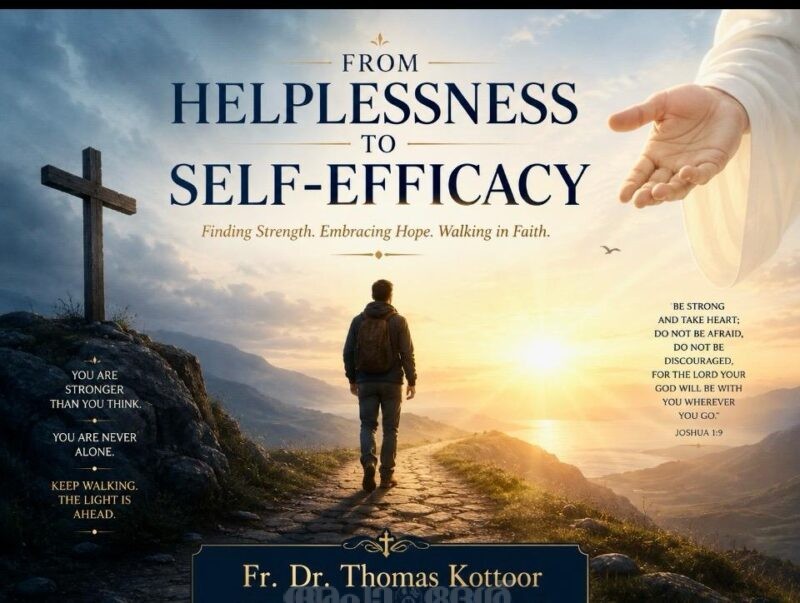
(Fr. Dr. Thomas Kottoor)
There are moments in life when the body grows weak, the mind grows tired, and the heart quietly whispers, “I cannot go on anymore.” Yet history, psychology, and faith all tell us the same profound truth: human beings are often stronger than they imagine.
Take the life of Frédéric Chopin (1810-1849). The great Polish composer was dying of tuberculosis. Every breath became painful. His body was slowly fading. But he never stopped composing. Some of the most moving music he ever created emerged from those final seasons of suffering. Even while death stood near him, beauty continued to flow through his fingers.
That is why Chopin’s music still touches hearts across generations. It carries the sound of a soul that refused to surrender.
A similar insight came from Bruno Bettelheim, who survived a Nazi concentration camp. He later wrote about a haunting pattern he witnessed among prisoners. Those who quietly gave up inside , those who told themselves, “It is over. I cannot continue” often did not survive long afterward. Their bodies were still present, but their inner will had already collapsed.
This tragedy does not belong only to concentration camps. It happens silently in ordinary life too. Many people stop living emotionally long before life itself ends. They lose hope, stop trying, and slowly surrender from within.
The Habit of Giving Up
Psychologist Albert Bandura gave a name to the inner strength that keeps people moving forward: self-efficacy.
Self-efficacy is the deep conviction that “I can handle this. I can face what life brings.” When people believe they are capable, they usually discover strength they never knew they possessed. But when that belief disappears, even talented and intelligent individuals can become powerless.
Another psychologist, Martin Seligman, demonstrated this through a famous experiment at the University of Pennsylvania. Dogs were placed in cages and subjected to electric shocks at random intervals. Whatever they did – running, jumping, turning – nothing stopped the shocks. Eventually the animals stopped trying altogether. They simply stood still and endured the pain.
Later the dogs were moved to another cage where escape was actually possible. A small movement to one side would stop the shocks completely. Yet the dogs did not move. They had already learned a tragic lesson: nothing they did mattered. Psychologists call this “learned helplessness”.
Human beings fall into the same pattern. Repeated failures, harsh criticism, disappointments, fear, rejection, or a fatalistic attitude toward life slowly teach people to stop trying. We begin to believe that nothing will change anyway. So we remain where we are, even when doors are quietly standing open before us.
Finding Your Way Back
The hopeful truth is this: helplessness is not destiny. It is a learned habit and habits can be changed.
The journey back begins gently.
First, believe that strength already exists within you. This is not empty optimism. It is the inner fuel that makes action possible. Every human being carries hidden reserves of courage that appear only when life demands them.
Second, recognise that you have more influence over your life than you think. Both failure and success carry your fingerprints. This is not meant to create guilt. It is meant to awaken responsibility and hope. If your choices helped shape yesterday, your choices can also shape tomorrow.
Third, make peace with your failures. Do not carry them like chains. Failure is not proof that you are worthless; it is often the soil where wisdom quietly grows. Carry the lesson forward, but leave the wound behind.
Fourth, learn from people who overcame difficulties you now fear. Read their stories. Study their lives. The autobiography Wings of Fire by A. P. J. Abdul Kalam is one such inspiring example of resilience and determination. His book, “Indomitable Spirit” is also a good read.
Fifth, remember this deeply: you may not always be able to change your circumstances, but you can always choose your response to them. That freedom remains yours. And for those who believe in God, there is another quiet strength available – the grace that walks beside us even in darkness. “ Do not be afraid, I am with you”.
Faith does not remove every storm. But it can keep a person standing within the storm.
End Note: The Ten-Rupee Bet
A soldier lay critically wounded on a battlefield. A doctor examined him briefly and whispered to the chaplain, “He will not survive.
” The chaplain knelt beside the young man and spoke softly.
“Son, your injuries are serious. Is there anything you would like me to tell your family?”
The soldier slowly pointed toward the inside pocket of his coat. The chaplain reached in and found a small diary. Inside it was a ten-rupee note.
“Is this what you wanted?” the chaplain asked.
The wounded soldier looked at him steadily and whispered,
“Father… I am not going to die. That ten rupees is a bet.” And he survived.( Quoted in A.P.Perera’s Book, “ Success in thirty Days”.
Sometimes the greatest miracle begins with a simple inner decision: I will not give up.
That decision can awaken extraordinary strength within a person – a strength greater than fear, failure, suffering, or despair. Call it resilience. Call it grace. Call it the power of the human spirit sustained through prayer and grace of God. Whatever name we give it, one truth remains: It is real. And it lives within every one of us.