


( Fr. Dr. Thomas Kottoor)
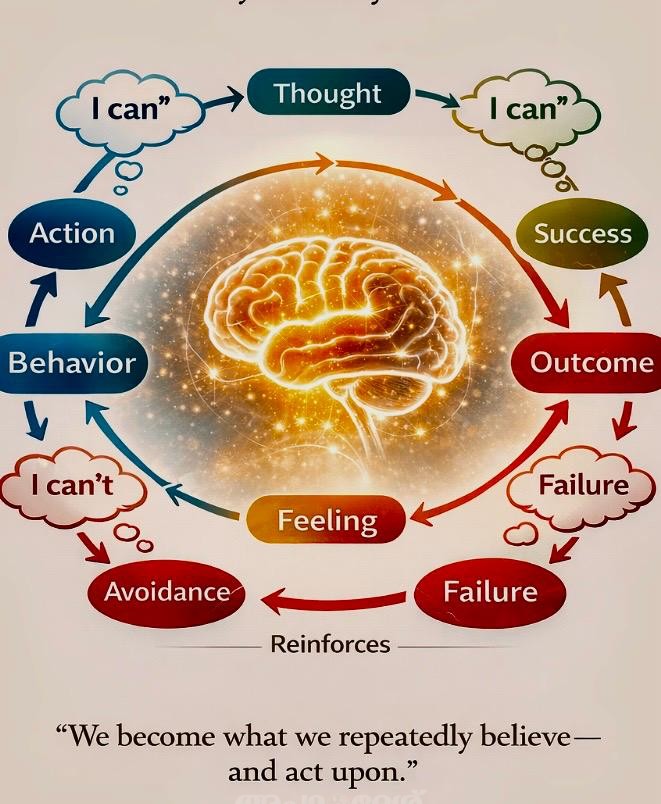
Have you ever noticed how a small thought can quietly follow you through the day? You wake up with a feeling “Today may not go well.” And somehow, things begin to fall into that pattern. A delay irritates you. A small mistake feels bigger than it is. By evening, you sigh, “I knew it.” But pause for a moment. Was it the day that went wrong or the story you carried into it? The Mind Listens-Always. Our brain is not just an organ that thinks. It is an organ that learns from repetition.When you keep telling yourself something good or bad, the brain begins to believe it. It strengthens those thoughts, like a path that becomes clearer each time you walk on it. Slowly, what you repeat starts to feel like truth.
“I am not capable.” “I always fail.” These may not be facts. But if you say them often enough, the mind begins to organize your life around them. You hesitate more. You try less. And life, in a quiet way, starts proving you right.
A self-fulfilling prophecy is a prediction or belief that becomes true (at least partly) precisely because someone believes it will happen and then acts in ways that make it come true.
The term was coined by sociologist Robert K. Merton in 1948. He defined it as: “a false definition of the situation evoking a behavior which makes the originally false conception come true.” This is the self-fulfilling prophecy.
In simpler terms: Your expectation (even if originally incorrect or unfounded) influences your behavior, and that behavior helps create the very outcome you expected. How It Works (The Basic Cycle)
1. You hold a belief or expectation about a situation, person, or yourself.
2. That belief affects how you think, feel, or act (often unconsciously).
3. Your changed behavior influences the actual outcome.
4. The outcome matches your original expectation reinforcing the belief.It can be positive or negative.
1. Repeated Thoughts and Beliefs Strengthen Neural Pathways
•When you hold a strong belief or expectation (e.g. “I’m bad at public speaking”), your brain treats it as a predictive model.
• Every time the thought arises or you act in line with it (avoiding practice, feeling anxious), those neural circuits fire together , “ neurons that fire together wire together” (Hebb’s rule, a core principle of neuroplasticity)
Common Real-World Examples Negative examples • You think “I’m going to fail this exam ; interview or presentation”. You feel anxious, study (prepare) less effectively, appear nervous or unconfident. Then you actually perform poorly and say, “ See, I knew I would fail.”
• Someone believes “Nobody likes me, I am bad at making friends”. They act withdrawn, avoid eye contact, give short answers, seem uninterested. Others respond by keeping distance ,the person feels even more rejected.
• Classic historical case (a well run financial bank some years ago crashed because the rumours spread that a bank is failing . The depositors became panic and rush to withdraw money . The bank actually runs out of cash and the rumour “comes true”.
Positive examples
• You believe “I’m going to do really well in this job interview”. You prepare thoroughly, feel calm and confident, smile more, speak clearly. You perform strongly and get the job ,your positive belief helped create success.
• Pygmalion effect (famous psychology study): Teachers were told certain students were “intellectually gifted” (randomly chosen).
Teachers gave those students more attention, encouragement, and higher expectations. Those students actually showed larger IQ gains over the year -the teachers’ expectation became self-fulfilling. But here is the beautiful turn in the story. But it can happen the other way too
A Gentle Shift that changes everything .
What if you begin to speak differently to yourself?
Not in a loud, artificial way-but gently, patiently.
“I am learning.”
“I can try again.” “I may not be there yet, but I am moving.
” At first, it may feel unfamiliar. Even uncomfortable. But the brain listens. Slowly, new pathways begin to form. Confidence doesn’t arrive like a storm-it grows like a sunrise. Quiet, steady, real.
You begin to act differently. And then, life begins to respond differently. . Modern Neuroscience Views the Brain as a “Prediction Machine”
• Theories like Karl Friston’s free energy principle : Bayesian brain describe the brain as constantly making predictions to minimize surprise.
• Expectations (beliefs) shape predictions perception, emotion, motivation, and action adjust to make the prediction come true self-fulfilling prophecy at the neural level.
• Neuroplasticity is the mechanism that updates (or entrenches) these predictive models based on experience. More Than Thoughts: The Power of How You Act Now here is something even more powerful.
It is not only what you think , it is how you behave. A kind word when you feel irritated. A moment of patience instead of anger. A small encouragement to someone who is struggling.
These are not small things. Every positive action strengthens a positive belief within you and within others. You are not just reacting to life; you are shaping it. Self-fulfilling prophecies exploit neuroplasticity’s double-edged nature:
• Negative ones can “lock in” limiting patterns (e.g., chronic self-doubt strengthening avoidance circuits).
• Positive ones can be deliberately harnessed (e.g., visualization and action create new empowering circuits). To break a negative loop or build a positive one, consistent repetition + emotion + behavior is key because that’s what drives meaningful plasticity. Techniques like cognitive behavioral therapy (CBT), affirmations paired with evidence/action, mindfulness, or deliberate practice all work by leveraging this exact brain mechanism.
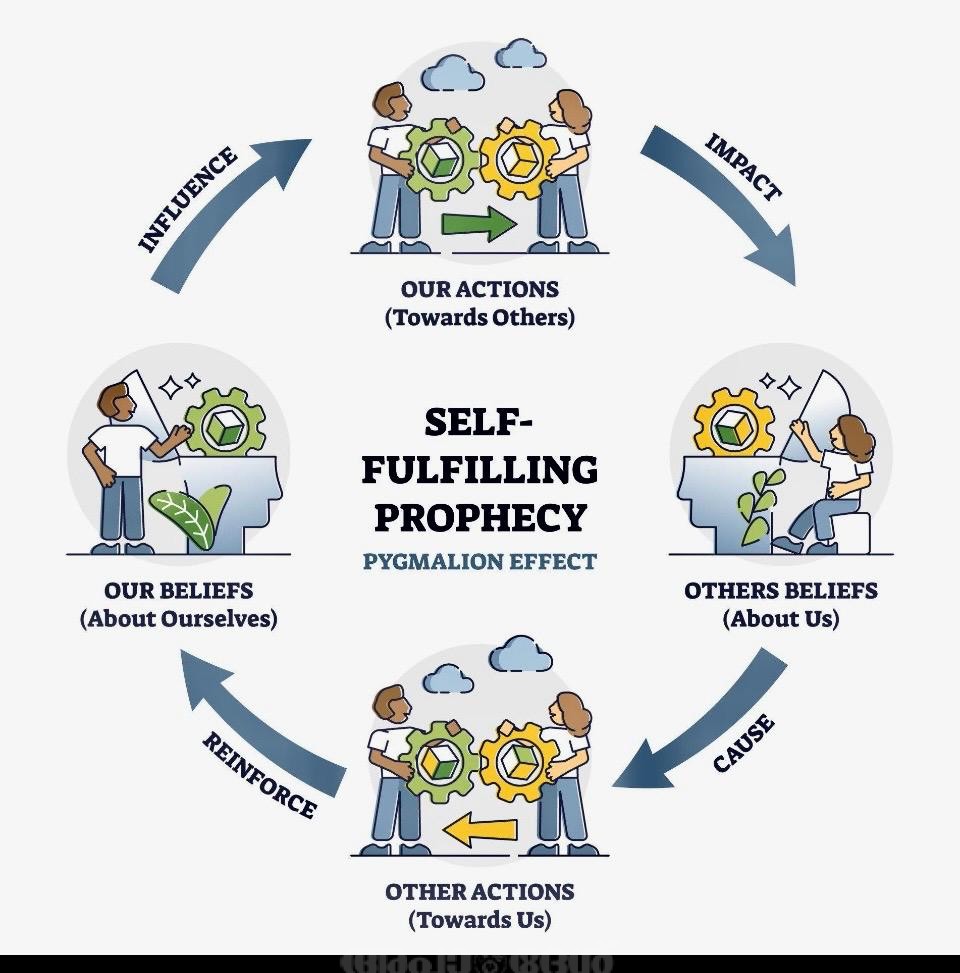
In short: self fulfilling prophecies don’t just influence behavior; they help sculpt the brain over time through neuroplasticity, which in turn makes the prophecy even more likely to keep coming true until intentionally interrupted.
You are also also writing other people’s stories.We often forget this.
The way you treat someone today may become the way they see themselves tomorrow. Tell a child, “You are capable,” and watch how they try. Trust a person, and see how they strive to be worthy of it. See goodness in someone, and slowly, they begin to live up to it.
People grow in the direction of the expectations they receive. You are, in quiet ways, helping to write their inner story.
Just begin here: Notice your thoughts. Choose them gently. Speak to yourself with a little more kindness.
Act with a little more patience. See others with a little more hope.
Bring out the best in yourself… and in others.
These are small steps. But they carry quiet power.
Because over time, thoughts become beliefs… beliefs become actions… and actions become life. What is the one sentence you keep telling yourself these days?
Is it building you or slowly breaking you? If needed, change that sentence.
Make it softer.
Make it stronger.
Make it life-giving.
Because somewhere within you, something beautiful is waiting to unfold.And sometimes, all it needs is a new story to believe in.
End Note:
“When you want something, all the universe conspires in helping you to achieve it.” (Paolo Coelho in ‘Alchemist’)