



(Fr.Dr.Thomas Kottoor, Sr. Lecturer in Psychology)
My recent reflections on brain plasticity stirred thoughtful responses. Some readers asked a very practical question: If the brain can change, how can we help it change?
That question is both scientific and deeply human.
The brain is not a rigid organ. It is living tissue, constantly rewiring itself. Neuroscience has shown that throughout life, the brain reorganizes, forms new connections, and adapts to experience. Brain is not aging as one age physically. This capacity is called neuroplasticity, the quiet miracle within us. Aging brain has become a myth.
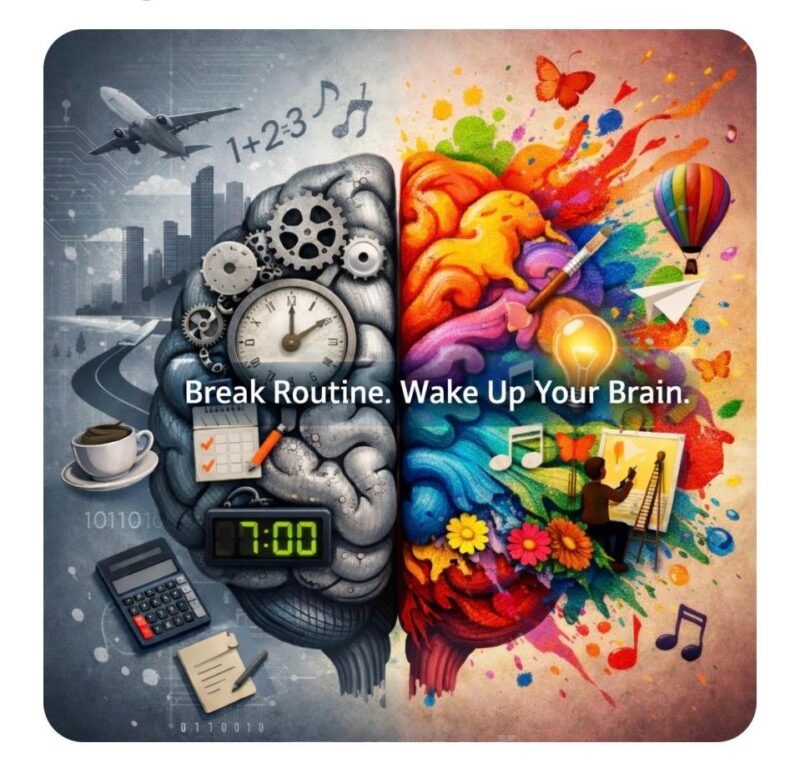
We often hear that the brain has two hemispheres: left and right. Structurally, they are mirror images. Functionally, they have tendencies. The left hemisphere is often associated with language, logic, mathematics, analysis, and symbols. The right hemisphere is linked to imagination, art, spatial awareness, emotion, and creativity.
Yet this division is not a battlefield. It is a partnership. Both hemispheres work together in a beautifully coordinated dance. Still, each of us may show a slight preference in how we process the world.
With that understanding, we can intentionally stimulate new neural pathways through small, deliberate changes. These exercises,sometimes called “neurobics” are not complicated. They are simple disruptions of routine. And routine, while comfortable, can make the brain economical rather than adventurous.
Below are practical ways to gently awaken your brain.
1. Break the Routine Routine is efficient, but novelty is growth.
• Get up from the other side of the bed.
• Switch on the light with your non-dominant hand.
• Brush your teeth or comb your hair with the opposite hand.
• Turn the tap or open doors using the less-used hand.
When you use your left hand, the right hemisphere becomes more engaged, and vice versa. The brain must pay attention. That attention is the seed of new neural connections.
2. Close Your Eyes and Feel. While changing clothes, briefly close your eyes and rely on touch. Feel textures. Notice temperature. Distinguish fabrics. When vision is removed, tactile and sensory circuits become more active. The brain learns to interpret the world through another gateway.
3. Change the Sound That Wakes You.
We often wake to the same alarm tone for years. Change it. A new sound prevents the brain from going into automatic mode. Even a small auditory surprise activates alertness and attention networks.
4. Introduce Variations in Smell
Our sense of smell has deep emotional and memory connections in the brain.
• Try a different soap or shampoo.
• Change your moisturizer.
• Vary your aftershave or toothpaste.
Novel scents stimulate limbic circuits—areas connected to memory and emotion.
5. Transform Breakfast
Do not let breakfast be mechanical. Vary taste, colour, texture, and presentation. Sweet one day, savory the next. Different fruits. Different shapes. Different aromas.
When multiple senses are engaged together, richer neural patterns are formed.
6. Walk a New Route.
Take a different path to a familiar destination. The brain must map new spatial patterns. Even slight geographical variation stimulates the hippocampus-the region associated with memory and navigation.
7. Engage the Ears.
Read aloud instead of silently. Listen to someone else reading. Music is especially powerful. Classical compositions, devotional chants, instrumental pieces, songs in different languages-all activate varied neural networks. Lyrics stimulate language circuits; rhythm engages motor areas: melody activates emotional centers.
The brain resonates differently with each genre.
8. Practice Tactile Discrimination.
Close your eyes and identify objects only by touch. Coins, keys, fruits, fabrics-let your fingers become curious explorers. This strengthens sensory processing and cortical representation.
9. Be Socially Curious.
Meet new people. Visit a different coffee shop. Attend a gathering outside your usual circle. Engage in conversation with someone whose background differs from yours.
Social interaction activates complex cognitive and emotional networks. The brain thrives on relational exchange.
10. Nurture Life.
Grow a plant. Tend a small vegetable garden. Nurturing something living cultivates patience, observation, responsibility, and emotional connection. It also reduces stress protecting the brain from cortisol’s harmful effects
11. Add Creative Challenges
Here are a few additional ideas:
• Learn a few words of a new language.
• Memorize a short poem.
• Sketch something you see.
• Write with your non-dominant hand for five minutes daily.
• Try simple mental arithmetic without a calculator.
• Practice mindful breathing for five minutes. Each new challenge is like opening a window in the brain.
A Gentle Reminder:
Neurobics are not magic tricks. They are invitations. Small changes create subtle sparks. Repeated sparks become patterns. Patterns become pathways. Pathways become new capacities.
The brain does not demand grand heroism. It asks for curiosity.
In a world that often numbs us with repetition, choosing novelty is an act of self-renewal. When we stretch the brain, we also stretch perception, empathy, creativity, and resilience.
Empowering the brain is not merely about sharper memory or quicker thinking. It is about remaining alive, mentally awake, emotionally responsive, spiritually attentive. Let us continue to explore. Let us help one another.